


By Amos Aar
WHEN trucks were about to roll into the Makurdi International Market camp last Saturday to begin the phased return of internally displaced persons (IDPs) from Yelwata, what unfolded was neither a hasty nor arbitrary exercise. Instead, it was the culmination of weeks of consultations, community requests, and formal assessments.
Contrary to viral claims of forced relocation, investigations by this reporter reveal that the initiative to return the Yelwata IDPs to their ancestral homes originated from within the community itself. The Benue State Government, acting through its Ministry of Humanitarian Affairs and Disaster Management, merely responded to repeated written and verbal appeals from Yelwata leaders. These leaders cited overcrowding at the camp due to the presence of Tiv IDPs from Nasarawa and Taraba states, who were benefiting from relief materials meant for Yelwata IDPs, as well as a desire to reclaim and rehabilitate their homeland.


The process began formally with a letter reportedly signed by the District Head of Nyiev, Chief Bernard Shawa, addressed to the Benue State Government, requesting support for Yelwata indigenes taking refuge in Makurdi to return home. In response, the Commissioner for Humanitarian Affairs and Disaster Management, Hon. Aondowase Kunde, led two interface meetings with community leaders to verify the authenticity of the request and assess the conditions for return.
At the first meeting, held on June 21, 2025, in Yelwata, the village head, Chief Kumaga Jõr, and the Parish Priest of St. Joseph’s Catholic Church, Yelwata, Rev. Fr. Jonathan Ukuma, reiterated the community’s position. They insisted that the people were willing to return, if only for the chance to rebuild and regain control of their lives.
A second assessment was conducted on July 3 by officials of the Benue State Emergency Management Agency (SEMA), led by Dr. Donald Komgbenda, alongside international humanitarian partners. The team visited Yelwata to assess the security situation, inspect basic infrastructure, and consult the community again on their readiness. Once more, a respected elder and retired schoolteacher, Mr. William Anger, Chief Jõr, and Rev. Fr. Ukuma stood firm, emphasizing the frustrations many of their people faced in camp life.
One of the strongest arguments came from Mr. Anger, who pointed out that Yelwata land had become vulnerable to encroachment, especially as some locals had refused to abandon the area altogether, fearing that herders would take over their farmland and homesteads. He also lamented how the IDP population in Makurdi had swelled beyond manageable levels due to the influx of displaced Tiv people from Kadarko in Nasarawa State and parts of Taraba.
“Those people are eating food and collecting materials meant for us. This is not fair. Our children are suffering. We want to go back and start again,” Anger stated. “Even if the government cannot protect us, let us all perish in our land.”
Father Ukuma, however, took a more inclusive stance, advocating that all victims, regardless of origin, should be entitled to relief support. He stressed that rebuilding the community — both physically and spiritually — could only begin with the return of the displaced.
The Commissioner’s office later convened a coordination meeting with international partners, including IOM, BENGONET, WHO, UNICEF, UNFPA, Women Affairs Community Links, BERWASSA, BSBS, and Jireh Doo Foundation (JDF), to discuss logistics, security, medical support, trauma response, and reintegration procedures. These agencies were present both at the camp and during field visits to ensure a collaborative and transparent process.
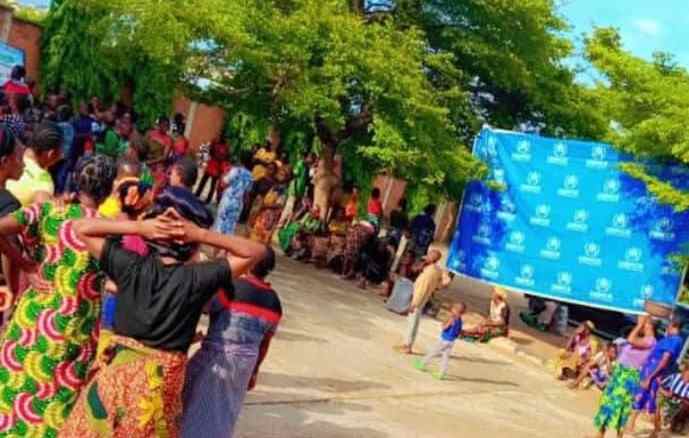
On Friday, July 4, a day before the scheduled return was to begin in batches, this reporter visited the Makurdi International Market Camp. A cross-section of IDPs, including women and the elderly, confirmed that the return plan was not only known to them but was actively supported by their local leaders.
However, they expressed bitterness over conditions in the camp. Some accused camp officials — ironically, fellow Yelwata indigenes — of hoarding relief items and distributing them selectively to girlfriends, relatives, and cronies.
“Some old women like us don’t get anything. They only give food and materials to their people. There is no freedom here. We are caged,” one elderly woman said.
Another mother, who asked not to be named, added: “Yes, some of us are afraid. But we are also tired. We want to go home and find peace.”
What followed the next day was a social media twist that shocked many involved in the relocation planning. A Facebook post went viral Saturday morning, claiming that the Yelwata IDPs had staged a major protest overnight, rejecting their return and accusing the government of coercion.
The post read in part: “BREAKING NEWS: PROTEST HITS BENUE IDP CAMP AS YELEWATA IDPs REJECT FORCED RETURN, DEMAND SECURITY AND HEALING.”
It alleged that displaced women, children, and the elderly had taken to the camp corridors, demanding a halt to what they called “premature and unsafe” resettlement, with some quoted as saying:
“We watched our families burn. We are not ready.”
The post also accused unnamed elites from the community of hijacking the decision-making process and failing to consult the actual victims.
However, on-the-ground interviews and documented evidence from multiple open meetings contradict the claims of secrecy or imposition. In fact, during the final pre-departure meeting, Chief Jõr and Mr. Anger placed a phone call on speaker to District Head Chief Bernard Shawa, who once again confirmed his endorsement of the return plan.
This episode highlights a broader dilemma facing post-conflict communities across Nigeria: the tension between urgency and safety, hope and fear, agency and trauma. The trauma is real — and so is the desire to move forward.
In the words of Rev. Fr. Ukuma: “You don’t wait for everything to be perfect before you rebuild. If we stay in Makurdi forever, then we’ve surrendered. We can rebuild and mourn at the same time.”
The Yelwata IDPs may not be marching home in triumph, but they are walking back with intent — grieving, cautious, yet unwilling to be forgotten. For them, reclaiming their place on the map is as much about survival as it is about dignity.
