


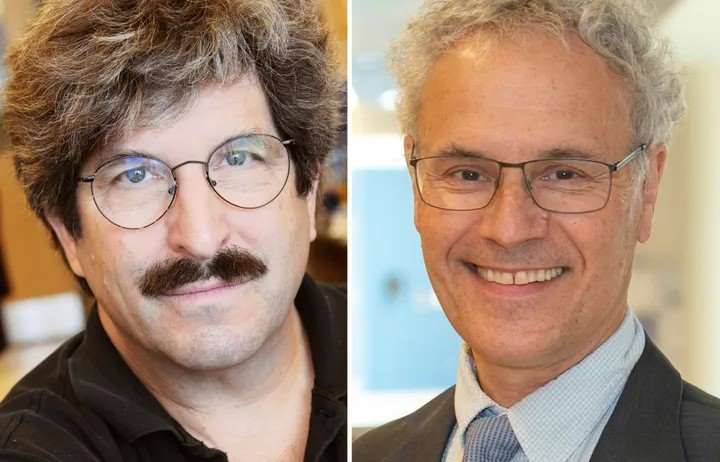
THIS YEAR’s Nobel Prize for Medicine or Physiology has on Monday been awarded to two scientists, Victor Ambros and Gary Ruvun, for their discovery of microRNA and “its role in post-transcriptional gene regulation.”
MicroRNA are tiny bits of genetic material that serve as on and off switches inside cells that help control what the cells do and when they do it.
Today’s prize was the first to be announced this year. Prizes will continue to be announced through October 14, 2024.
MicroRNA plays an important role in gene regulation and how organisms develop and function.
Ambros, currently a professor of natural science at the University of Massachusetts Medical School, performed the research at Harvard University.
Ruvkun’s research was performed at Massachusetts General Hospital and Harvard Medical School, where he’s a professor of genetics.
MicroRNA is a new class of RNA molecules that play an important role in gene regulation and how organisms develop and function.
The microRNA, first discovered in ringworms in the 1990s, is a type of RNA molecule that helps cells regulate gene expression and control the amount and type of proteins they produce.
Gene regulation tells cells how to behave. It is responsible for the differences between a muscle and nerve cell, for example.
MicroRNA added a previously unknown intermediate step in the conversion of genes to proteins. Proteins are responsible for virtually every human action from breathing to talking and even thinking.
“Having a basic understanding is of course the first step towards developing applications,” said Gunilla Karlsson-Hedestam, an expert in immunology and chair of the Nobel Committee.
“Although there are no very clear applications available yet with microRNAs, understanding them, knowing that they exist, understanding their regulatory networks is always the first step.” She added, noting that there are several ongoing microRNA trials trying to figure out how to combat cardiovascular and kidney diseases.
Last year’s winners include Katalin Karikó, a Hungarian-born scientist and American, Drew Weissman, for discoveries that paved the way for the development of highly effective mRNA vaccines against covid-19.
The next Nobel Prize to be awarded on Tuesday by the Royal Swedish Academy of Sciences will be the Prize in physics.
