


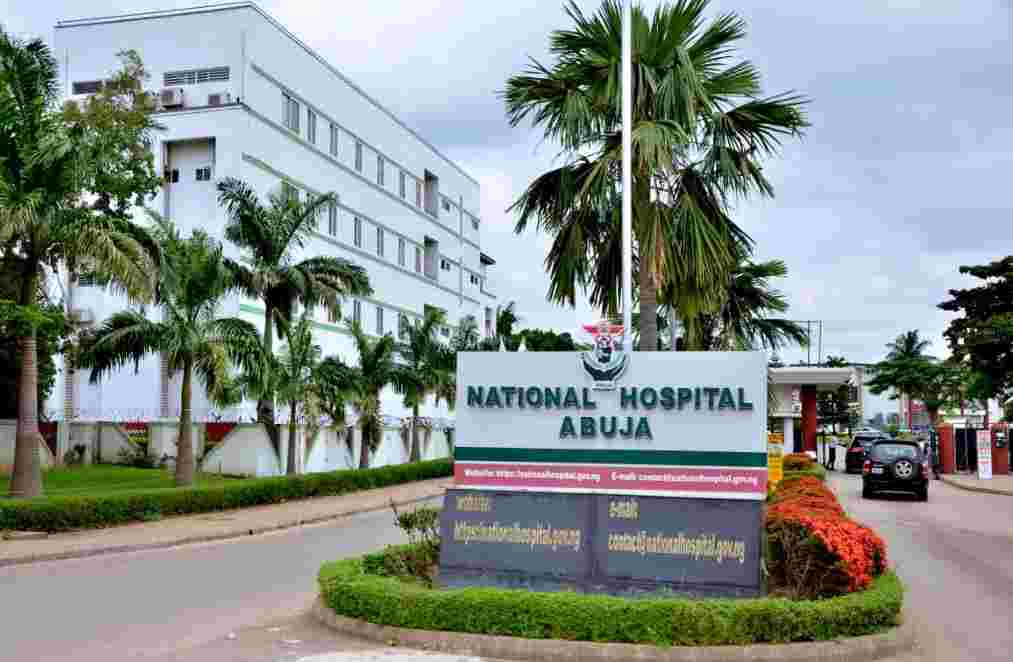
- Says Brain Drain Depletes Staff Strength To 2,500
By Abujah Racheal
THE NATIONAL Hospital, Abuja, has unveiled an ambitious plan to establish a state-of-the-art medical facility in Nigeria, aiming to reduce the country’s dependency on medical tourism.
The hospital’s Chief Medical Director (CMD), Prof. Muhammad Raji, announced this in an interview with the News Agency of Nigeria (NAN) in Abuja on Tuesday.

Raji explained that the proposed plan would create specialised medical services such as cardiac surgery, kidney transplants, and orthopaedic procedures – treatments that often drive Nigerians to seek care abroad.
“By providing these treatments here, we can keep our patients in the country and offer them the same quality of care,” he stated.
He also revealed plans to create a Neuro-Rehabilitation Centre, a facility currently lacking in Africa. This, he said, would address the continent’s critical healthcare gaps.
He urged both the government and private sectors to support this vision, highlighting that such a facility would not only improve healthcare outcomes but also contribute to Nigeria’s economic growth.
The CMD, observing that the government could not shoulder the financial burden of healthcare alone, called for increased private sector involvement to bring in much-needed resources and innovation.
According to him, there’s a need for a stronger collaboration between the government, private sector, and philanthropists to address the pressing challenges facing Nigeria’s healthcare system.
“The government has many priorities, and while health is indeed one of them, we cannot solely depend on the government to cover hospital bills and other healthcare costs. We must engage philanthropists and private companies to contribute to healthcare services,” he said.
He also raised alarm over the dire consequences of power outages in hospitals, describing the situation as a crisis in itself.
He called for urgent government intervention and the exploration of alternative energy sources to mitigate the impact of power failure on healthcare delivery.
“Hospitals need to operate 24 hours a day with consistent power. When the electricity goes off, critical machines like ventilators, which are vital for patients’ survival, shut down, thereby posing a grave risk,” he said.
He commended the recent increase in the minimum wage of Nigerian workers, acknowledging it as a positive step for motivating healthcare workers.
He, however, stressed that more still needed to be done to ensure sustainable healthcare financing.
Brain drain
Prof. Raji said the brain drain plaguing the health sector has reduced National Hospital’s workforce from 3,000 to 2,500, noting that this is in spite of its 25 years of medical breakthroughs and significant staff expansion.
Raji however highlighted the hospital’s achievements and its ongoing impact amid these staffing challenges, as he reflected on the hospital’s remarkable growth over its 25-year history, noting that it began operations with a small number of staff, offering limited services primarily for women and children.
“Today, we provide comprehensive treatment for all genders and ages. Our services have grown significantly over the years, and so has our workforce,” he said.
He mentioned that the hospital now has not less than 2,500 workforce. “If it was not for the brain drain affecting our workforce, we will be talking about 3,000 today,” he said as he underscored the hospital’s pioneering achievements, including being the first in Africa to have an Alinach Machine and leading in Nigeria for Invitro Fertilisation (IVF).
“Notable milestones include separating conjoined twins, performing the first open brain surgery with the patient fully awake, and pioneering treatments for chronic arthritis and brain surgeries. The hospital also celebrated the birth of sextuplets, all of whom survived,” he said.
He recalled that years ago, many Nigerians left for the Middle East for better opportunities, a trend that had recently resurfaced.
“The migration of healthcare professionals from Nigeria to other countries has reached alarming levels, posing challenges for maintaining adequate staffing in Nigerian hospitals.
“It’s not easy to get as many healthcare workers as we need, especially with the increasing number of professionals migrating abroad,” he noted.
However, he said he was hopeful about reversing the trend through innovative collaborations with the Nigerian diaspora.
“The hospital has established partnerships allowing Nigerian medical professionals working abroad to return on a rotational basis.
“These professionals spend two weeks here and then return at their convenience, benefiting both them and our healthcare system,” he explained.
He urged the government and private sector to create a conducive working environment to encourage more healthcare workers to stay or return to Nigeria.
He expressed optimism about re-engaging Nigerian medical professionals abroad through these collaborations, which helped improve the overall quality of healthcare services.
NAN reports that the National Hospital will celebrate its 25th anniversary with a week of activities from September 2-8, 2024
The main event on September 4 will feature lectures, a gala, and an award night.
The event will focus on the importance of partnerships in tackling challenges such as brain drain and medical tourism, aiming to attract both Nigerians and non-Nigerians to the hospital. (NAN)
